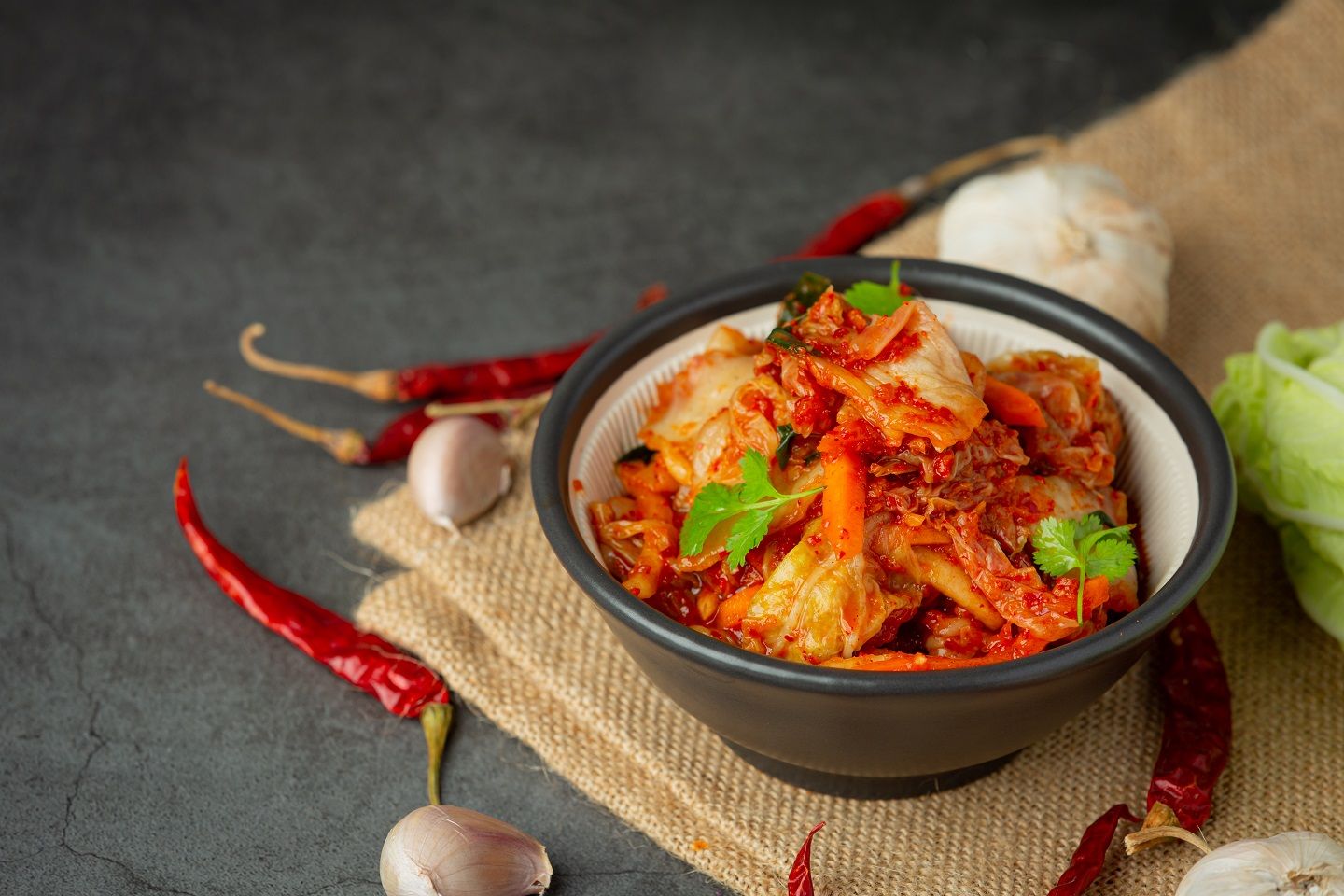
The heart and soul of Korean cuisine, kimchi is a classic and incredibly versatile dish. Over the years, it has made its name globally as a healthy probiotic food with its anti-cancer and anti-ageing properties. Healthy, delicious and flavourful, you can pair kimchi with just about any dish, so here’s how you can make this kimchi recipe in the comfort of your home.
Meal: Side Dish Cuisine: Korean
Preparation time: Cooking time: Total time: Yield: 48 servings
Ingredients
1.3kg of napa cabbage
2.25l of water
135g of sea salt
110g of coarse ground gochugaru (chilli powder)
25g of glutinous rice flour
30g of sugar
120ml of fish sauce
40g of Korean salted shrimp, minced
8 cloves of garlic, finely chopped
30g of fresh ginger, peeled and finely chopped
170g of Asian pear, julienned
115g of daikon radish, julienned
115g of carrots, julienned
115g of scallions, halved and cut into 2-inch pieces
Equipment
1 large knife
2 large bowls
1 small bowl
1 saucepan
1 whisk
1 rubber spatula
Cling film
Directions
Using a large knife, halve the napa cabbage lengthwise and slowly pull it apart, separating it into two pieces. Repeat with the halves to make quarters.
In a large bowl, add 1.9l of water and sea salt, mixing it until the salt is fully dissolved.
Add in the cabbage and thoroughly bathe each quarter in the mixture.
Shake off any excess water and transfer the cabbage into a separate bowl to set aside. Repeat with all the quarters.
In a small bowl, add the gochugaru and 120ml water and mix to combine. Set it aside.
In a saucepan, add in the rice flour, sugar, and 240ml water and whisk over medium heat.
Bring it to a light simmer, whisking it constantly until it forms a thick paste.
Add the paste into the gochugaru mix and set it aside.
Once it is cooled, stir in the fish sauce, salted shrimp, chopped garlic, and ginger and mix.
Add the Asian pear, daikon, carrot and scallions and using your hands, gently mix it until the components are thoroughly coated with the paste mixture.
Transfer it to a large bowl and add in the napa cabbage, one quarter at a time.
Starting with the outermost layer and working inwards, use your hands to spread the paste mixture to coat the cabbage leaves thoroughly. Repeat with all quarters.
Using a rubber spatula, scrape any leftover kimchi paste and add it into the large bowl.
Press down on the mixture to eliminate air pockets and cover the surface with cling film.
Let the kimchi ferment at room temperature for 8 hours and store it in the fridge after.
Serve whenever!
Fermentation period
This kimchi recipe calls for you to let it ferment for a minimum of 8 hours. However, if you’d like the flavour to seep in more and for your kimchi to reach its ultimate flavour, allow it to ferment for at least 3 days at room temperature and then in the fridge for another 2 days.
Missing some ingredients?
Stock up on your groceries with pandamart’s wide selection of quality ingredients and produce. Get your napa cabbage, gochugaru, and daikon radish delivered to you in just 20 minutes.